



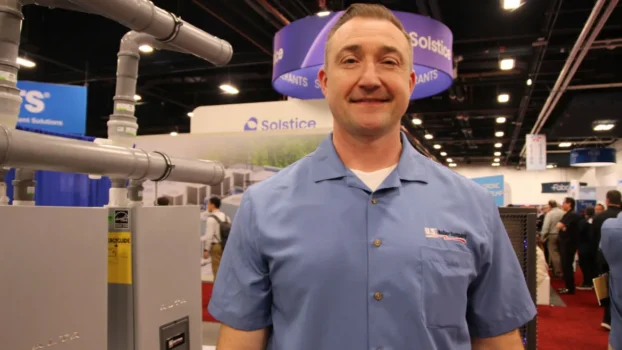
Charlie Kopplin discusses practical innovation, balancing advanced controls with hands-on usability, and how contractors are navigating new demands
If you spend time at ABMA’s Boiler Expo, AHR Expo or any other industry event, a theme quickly emerges: technology is advancing, but simplicity and reliability remain at the heart of what installers and building owners want. Charlie Kopplin, Director of Marketing at Heating Solutions Sales Company, says that the company’s approach is to make high-efficiency technology as easy to work with as possible, so contractors can focus on the job, not the manual.
U.S. Boiler’s latest residential models, such as the ALTA boiler, are designed with OneTouch™ technology so that complex commissioning and combustion tuning happen with minimal input, using built-in adaptive controls that monitor and adjust performance over time. “You just push a button, and it commissions itself,” Kopplin explained. “And then it keeps checking, keeps learning, keeps optimizing all on its own.” For contractors, this means less time spent on setup and fewer callbacks, especially in regions where fuel quality and weather can change quickly.
Recently, U.S. Boiler expanded its venting options to include the OneVent, common venting system that allows multiple boilers to work together in larger homes or light commercial spaces. “You can now vent multiple boilers together, and all that intelligence that worked for one, now works across a whole bank of them,” Kopplin said, referring to their line of ALTA boilers. The aim is to allow contractors used to residential work to scale up without having to learn an entirely new system.
There’s attention to practical details, too: switching between natural gas and LP is designed to be a simple process, and the self-commissioning controls reduce the need for additional sensors or setup steps. The company’s contractor app, USB-Connect, originally designed for residential jobs, now works with commercial products as well, using Bluetooth for on-site setup and diagnostics – without needing to tap into building Wi-Fi.
At the end of the day, Kopplin concludes, the focus is on design choices that make installs and service easier, not harder, and eliminating points of failure such as the outdoor reset sensor. “It’s one less thing for a contractor to worry about, and one less thing for a building owner to have fail.” For an industry juggling innovation and reliability, the goal is simple: technology that fades into the background and just works.