



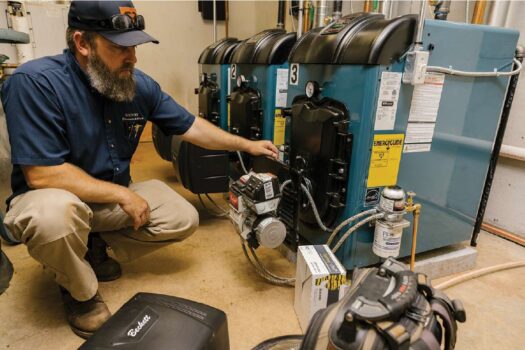
I’m going to open this article with the very best piece of oil boiler advice I can give: Always check for oil leaks upon arrival and departure.
Having said that, while oil burner technology has certainly progressed since the introduction of the power oil burner, some of the basic premises, which are critical to clean and reliable operation, have not changed much.
The most rudimentary, yet critical, step is to ensure an ample supply of clean oil. While this appears to be a simple concept, it’s one the tech support teams deal with frequently.
Examining the Oil Delivery System
For clarity, it’s easiest to tackle this topic in stages. When responding to a no-heat call, the problem may be related to one of several different systems; one of these is the oil delivery system.
First, check oil delivery to the nozzle assembly. To do so, remove the nut on the high pressure (nozzle) line at the nozzle assembly. Divert the line into a container by either loosening the nut at the pump and spinning the line or attaching a hose to either the nozzle line or nozzle line port on the pump.
Reset the boiler, and then monitor the discharge from the oil line after any solenoids open (if present). If the oil discharge is solid and free of air bubbles, the problem is likely elsewhere in the burner or heating unit. If the oil flow is sporadic, foamy or non-existent, this is a good indication of a restriction in the oil system; failed or slipping pump coupling; a bad pump, solenoid or primary control solenoid output; or possibly an out-of-oil condition.
If the burner motor runs but no oil is present at the nozzle line during ignition, check for an empty oil tank; bad solenoid; broken or slipping pump coupling, air bound or restricted oil line; bad primary or possibly a bad pump.
Once it’s determined that the issue is related to the oil supply, analyze the type of system you are dealing with. Is the oil line feeding the pump in a vacuum or gravity application? If it’s a gravity system, check the oil level in the tank (also confirm the gauge is accurate—the gauge can stick and indicate oil is present when the tank is actually empty).
If the tank has adequate oil, move on to the filter. Assuming it is a gravity-feed type of system, close the Firomatic Fire Safety Valve or standard service valve at the bottom of the tank or inlet of the filter. Then, remove the filter from its canister and open the valve between the tank and filter head. Oil should flow freely from the filter head. The higher the oil level in the tank, the more flow should be present at the filter head. A full tank with barely a trickle of flow at the filter head indicates a restriction in the tank, tank valve or filter head inlet. It’s preferable but not always possible to use a push/pull pump to draw the blockage out of the tank with suction. Regardless of method, take steps to resolve this issue.
How the next step is completed is a personal preference, but you must confirm that all elements of the system are clear. I recommend installing a new filter but not purging the air at the filter. On a pump with a removable strainer, (Suntec, Danfoss, Riello, etc.) remove the pump cover. On a pump with no strainer (Webster or similar), remove the oil line from the pump and drain into a container. If that’s not possible, attach a hose to the oil line and drain it into a container. A 3/8″ male flare x 1/4″ NPT fitting (1/2″ flare x 1/4″ male if it’s a half-inch line) with a hose connected to the threaded end will make this quick, neat and easy.
Next, turn on the oil valve at the tank and check for oil safety valves (OSV). These devices are designed to prevent oil spillage in the event of a line leak or pump seal failure. If an OSV is present, insert the bypass key. Allow the air bubble from the filter to pass through the line and vent through the pump cover/oil line. Remember, gravity is working its magic here. The oil level in the tank must be higher than the discharge point. This can be an issue on highboy-style hot air furnaces with low oil tank levels, as the burner is at a higher elevation than on most boilers.
If the oil flow at the pump is reduced excessively from the flow at the filter head, the oil line is restricted and must be cleared or replaced. Check with your service manager or insurance company on oil line protocol; restrictions may apply on using CO2 charges to clear lines.
Always pay attention to what equipment is attached to the oil lines. If the oil line serves multiple units, the other units must be isolated from the oil line when cleaning. Do not trust the fire valve at the pump for isolation. More than a few pumps have gone to an early grave because the seal was damaged during oil line service.
The best way to protect attached pumps is to remove the pump cover when flushing the lines; alternately, one may remove the oil line and plug with a flare plug. If removing the pump cover, close the Firomatic valve fully and tap on the stem to fully seat. Wrap a rag around the cover and place a container beneath just in case the fire valve doesn’t fully close. If you don’t take preventative steps and the valve leaks during flushing, it can get quite messy. I recommend never using CO2 or any high-pressure method to clear oil lines that are buried.
Again, careful use of a push/pull gun may be helpful, particularly when combined with a cleaning solution suitable for #2 fuel. Use care, as even a push/pull gun can create very high pressure. If necessary, replace buried fuel lines with above-ground lines in accordance with local and national codes.
Once the oil line is confirmed to be clear, reassemble the system, installing a new or clean strainer and gasket where applicable. Purge the pump of any air using the bleed port. If the pump coupling is intact, the solenoid (if present) will be functional and energized during ignition, and the oil system will be in order; the next step is replacing the pump if the issue persists.
Two-Line Systems
When dealing with a two-pipe or suction oil system, most of the above items are still relevant but there are still a few more things to check.
Air leaks can be problematic and can cause atomization issues and oil leakage from the nozzle during the off cycle, as well as contribute to early pump failure. In addition to the items mentioned pertaining to gravity systems, it’s important to check for air or restrictions. Most often, a leak in a suction system will allow air in, as opposed to a gravity system, which will leak oil out.
An “oil watcher” is a clear plastic tube with a vacuum gauge attached. This device typically features 3/8″ flare fittings; a male on one end and female on the other. As well, 3/8″ x 1/2″ adaptors are normally included for larger oil lines. This tool can be used for checking air leaks or restrictions in the oil line. When combined with a valve, it may also be used to check the pump, including the shaft seal, for leaks.
A visual inspection of the area around the pump shaft may reveal a pump seal issue. If the area around the pump seal is wet with oil, this may indicate a seal leak. To be sure, fill the pump and oil line with oil. Confirm fittings are tight with no leaks. With the oil watcher in place, close the inlet valve on the upstream end of the oil watcher. Start the boiler.
The pump should develop a certain level of vacuum and maintain the level after the burner shuts off (check the pump manufacturer’s specs for expected vacuum level and allowable deterioration rate). If the vacuum slowly dissipates, you either have a fitting leak or bad pump seal.
With the burner running, check for excessive vacuum or air bubbles at the pump inlet. Depending on oil line piping orientation and pump type, inlet vacuum pressure can become a problem at levels as low as 4″ of water column (wc). Excessive vacuum can be caused by oil line/tank/filter blockages; jammed check or foot valves on old in-ground tanks; or undersized lines/excessive line length. Air can be introduced from leaking fittings or by outgassing.
Under elevated vacuum, fuel oil will outgas and introduce air bubbles to the system. The old rule of thumb was 1″ for every 1′ of vertical rise not offset by a corresponding drop at the boiler, and 1″ for every 10′ of horizontal run plus additional loss for filters, fittings, etc. (OSVs can be as high as 3″ wc).
After diagnosing the oil system and resolving any issues, the final step is to install a new nozzle based on manufacturer recommendations. Be aware that a nozzle’s flow rating is only valid at 100 psi. Currently, many burners run higher nozzle pressure—at 180 psi.
Next, service the electrode assembly, gap the electrodes correctly and check the pump discharge pressure on the nozzle line. Confirm that the nozzle line pressure meets manufacturer specifications and that the pump cut-off is holding after shut-down.
Pay careful attention to potential gelling in outside tanks in areas subject to low temperature. Further, be sure to always wipe all lines/fittings dry and check all devices and fittings for oil leaks prior to leaving.
If the pump must be replaced, be sure the replacement unit meets the original specs or site requirements. Most (if not all) pumps ship with the bypass plug “OUT,” and as such will install directly into a single-line system. If you have a two-line system and forget to install the bypass plug, this is known in our multicultural industry as “No Bueno.”
If you have a single-pipe system and install the bypass plug, this is known as “Super-Extra No Bueno” and will necessitate a return to the supply house for another pump, as the second you turn it on, the pump seal will blow out.
Always set the pump discharge pressure to the manufacturer’s specs for the heating unit.
Tools of The Trade
Indeed, some specialized tools will help expedite oil service. A standard pump-type oil squirt gun helps to prime dry pumps. Removing the upper supply port plug/fire valve will allow the pump cover cavity to be filled to aid in priming.
A push/pull gun is a versatile tool. It can help clear oil lines, flush chemical through the lines and pull oil to the pump on suction type systems with long pulls, among other things. An oil watcher is a clear tube with a vacuum gauge that allows the technician to see whether the oil has air bubbles prior to entering the pump, while simultaneously indicating vacuum level.
Another handy tool is a Kwik Check pump test kit. This device tests running pump pressure and has a valve to allow an easy test of the pump cut-off. A CO2 blow-out gun provides a quick means of clearing oil lines but may also result in ruptured oil lines. Again, check with your manager or liability provider to determine company policy on CO2 gun usage. A push/pull gun correctly applied in conjunction with appropriate solvent is more manageable in avoiding oil line failures that can result from the excessive pressure a CO2 blow-out gun can create, but use with care.
The Final Step
After repairs are complete, always check for leaks!
Remember the old adage, “Leaks take weeks.” They may also cause thousands of dollars in damage if site contamination becomes an issue. Wipe every line and fitting dry as soon as a task is completed and be sure it’s still dry upon leaving. Finally, after performing these tests, if you’re still unable to isolate the issue, consider contacting your local rep or corresponding manufacturer’s tech support.
In Closing…
While this article is comprehensive, it’s by no means exhaustive. All major residential oil burners are substantially similar in function, but in form, each has its idiosyncrasies. Fortunately, most manufacturers offer excellent training, both in person as well as online. I strongly suggest taking advantage of these resources, as they’ll help develop more competent and capable technicians. With the shortage of qualified labor in our industry, “speed is what we need,” but never at the expense of quality or safety. Proper training, tools, and the ability to make practical application of both, will allow the modern technician to provide safe, efficient and reliable oil system service.
Finally, always check for leaks!
Author:
Tom Secondino
Residential Products Technical/Application Team Leader for U.S. Boiler Co.
Tom Secondino has been in the mechanical trades for over 40 years. Starting out in a family-owned full-service oil company, he has had the opportunity to experience a wide variety of disciplines, from cleaning residential boilers to working on large chillers and scientific process equipment, and many things in between. He is an experienced teacher at a technical facility in Connecticut and remains passionate about educating others to fill the growing void of qualified technicians HVAC contractors are experiencing throughout the country. Secondino conducts training in person at the U.S. Boiler training center in Waterbury, CT, as well as remote training through web-based apps. Contact Secondino with any questions at techservices@usboiler.net.